

TL;DR: Corporate self defense workshops equip employees with practical safety skills through situational awareness training, verbal de-escalation techniques, and reflex-based physical defense. These sessions reduce workplace anxiety, fulfill your organization’s duty of care, and create a culture of empowerment—particularly vital for teams commuting through Mumbai’s late-night shifts or navigating Gurgaon’s corporate corridors.
The 9:47 PM local train pulls into Andheri. Your marketing manager clutches her laptop bag tighter as the crowd surges. Meanwhile, in Cyber City, your finance lead walks toward an empty parking lot after a late client call, keys wedged between knuckles—a gesture born from fear, not training.
These aren’t hypothetical scenarios. They’re the daily reality for thousands of corporate employees across Mumbai, Gurgaon, Delhi, and Bangalore. While companies invest heavily in health insurance and ergonomic chairs, physical safety remains an overlooked pillar of employee wellness. That oversight carries real consequences: heightened stress, reduced productivity, and potential liability under India’s evolving workplace safety norms.
A corporate self-defense workshop bridges this gap. Unlike traditional martial arts classes that require months of practice, these sessions deliver immediately applicable skills through three core pillars: Awareness (recognizing threats before they escalate), De-escalation (using verbal tactics to defuse confrontation), and Physical Defense (simple, reflex-based techniques for worst-case scenarios). This isn’t about turning your team into fighters—it’s about transforming vulnerability into confidence.
Why HRs in Mumbai & Bengaluru Are Prioritizing Employee Safety
Corporate self-defense training addresses region-specific safety challenges faced by employees in India’s major business hubs, with particular emphasis on commute security and workplace environment risks.
Mumbai: Navigating the Late-Night Shift Economy
Mumbai’s 24/7 work culture creates unique vulnerabilities. BPO employees finishing midnight shifts, advertising professionals wrapping late shoots, and healthcare workers commuting at odd hours face crowded locals, isolated auto-rickshaw rides, and poorly lit connector roads between stations and homes.
Micro-safety tip: When boarding the last local train, position yourself in compartments nearest to the motorman’s cabin or guard’s compartment—these sections have direct emergency communication systems. Always share your live location via WhatsApp before entering a cab, especially on the Western Express Highway stretch between Andheri and Borivali.
The dense urban landscape also means limited personal space. Corporate Swasthya sessions tailored for Mumbai professionals focus heavily on close-quarters defense—techniques effective in crowded elevators, packed train compartments, and narrow office corridors.
Gurgaon & Delhi: Safety in Corporate Enclaves
Gurgaon’s Cyber City, Udyog Vihar, and DLF phases house thousands of employees who often work late in high-rise towers surrounded by construction zones and poorly monitored parking structures. The disconnect between secure office interiors and vulnerable transition zones (basement parking, service elevators, isolated walkways) creates risk pockets.
Micro-safety tip: In multi-level parking facilities, always stand near the SOS button when entering elevators. If the button is non-functional or missing—common in older Gurgaon buildings—photograph it and report it to your facilities team immediately. This falls under your company’s duty of care obligations.
Delhi-based corporates face additional challenges around metro connectivity and last-mile transport. The gap between metro exits and office campuses often involves shared autos or app-based bikes where employees have limited control over route choices.
Bangalore: Tech Park Isolation & High-Traffic Commutes
Bangalore’s sprawling IT corridors in Whitefield, Electronic City, and Outer Ring Road present a different safety equation. Employees often leave campuses after dark into areas with minimal foot traffic, relying on company-provided cabs or ride-shares through congested, unpredictable routes.
The city’s traffic congestion also creates vulnerability windows—sitting in stationary traffic for extended periods, particularly on service roads near tech parks, where vehicle windows become exposure points.
5 Core Benefits of Self-Defense Training for Corporate Teams
1. Heightened Situational Awareness
Situational awareness training transforms employees from distracted commuters into alert professionals who can identify pre-contact threat indicators. This includes recognizing aggressive body language, identifying unsafe environments before entering them, and understanding the psychology of predatory behavior.
Employees learn the “Cooper Color Code”—a simple mental framework ranging from relaxed awareness (Condition Yellow) to full alertness (Condition Red). This isn’t paranoia; it’s calibrated attention that reduces reaction time during critical moments.
2. Boosted Confidence & Workplace Performance
Physical empowerment directly correlates with professional confidence. When employees feel secure in their ability to handle personal safety, that assurance extends into client presentations, leadership roles, and high-pressure negotiations.
[Insert Statistic on Workplace Safety Confidence and Productivity in India 2025/2026]
Women employees particularly benefit from this shift. In organizations where self-defense training is standard, we observe measurable increases in after-hours project volunteering and leadership program participation—behaviors previously limited by safety concerns.
3. Stress Management Through Physical Release
Self-defense workshops provide controlled, high-intensity physical activity that triggers cortisol reduction and endorphin release. Unlike gym sessions, these movements have cognitive purpose—your brain associates physical exertion with competence-building rather than obligation.
The tactical breathing techniques taught in de-escalation modules double as anxiety management tools applicable to everything from difficult client calls to performance reviews.
4. Unique Team Bonding Experience
Standard team-building activities—trust falls, escape rooms, paintball—feel artificial to many employees. Self-defense training offers authentic vulnerability. Partners practice wrist releases and blocking techniques, creating genuine trust through physical cooperation.
These sessions level hierarchies in productive ways. Your VP and intern learn the same elbow strike; competence in this domain isn’t tied to job title. That temporary equality often translates into better cross-departmental communication afterward.
5. Fulfilling Corporate Duty of Care
India’s evolving interpretation of workplace safety—particularly post-POSH (Prevention of Sexual Harassment) Act amendments—places increasing liability on employers to ensure employee security beyond office premises. While legal obligations around commute safety remain gray areas, proactive measures demonstrate organizational commitment.
Corporate self-defense training creates documentation that your organization takes employee duty of care seriously. In the unlikely event of an incident, evidence of preventive training strengthens your legal position while genuinely reducing risk exposure.
Connecting these three critical elements—employee duty of care, POSH compliance India, and physical safety ROI—creates a comprehensive wellness framework that satisfies both ethical obligations and business metrics.
What Happens in a Corporate Swasthya Self-Defense Session?
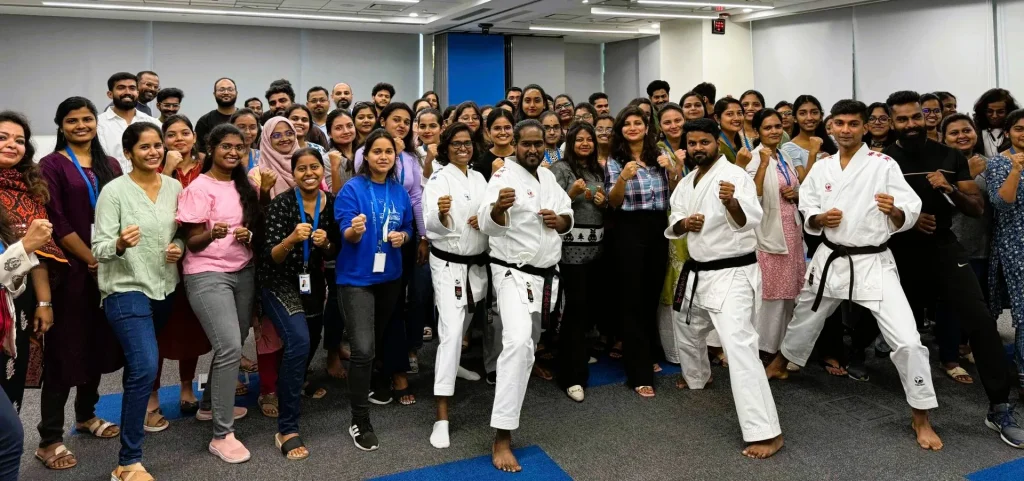
A typical corporate self-defense workshop is a 2-4 hour intensive session combining psychological education, verbal tactics, and physical skill-building, designed specifically for office environments and requiring no prior fitness level.
Step 1: Understanding Threat Psychology
The session begins with threat recognition training. Employees learn to identify pre-attack indicators: aggressive posturing, invasion of personal space, escalating verbal aggression, blocking exit routes, and the crucial distinction between territorial aggression (often avoidable) versus predatory behavior (requiring immediate response).
This segment includes video analysis of real confrontations—parking lot encounters, elevator incidents, street harassment—with facilitators pausing to highlight decision points where awareness or de-escalation could have changed outcomes.
Step 2: Verbal De-escalation Tactics
Most threatening situations can be resolved without physical contact through strategic communication. Employees practice the “broken record” technique (calmly repeating boundaries), strategic agreements (appearing to comply while creating escape opportunities), and voice projection exercises.
Specific scenarios include handling aggressive colleagues, deflecting unwanted attention in social settings, and responding to cab drivers who deviate from GPS routes—common concerns in Gurgaon’s less-regulated transport ecosystem.
Step 3: Reflex-Based Physical Defense
Physical techniques taught in corporate sessions prioritize simplicity over complexity. These aren’t martial arts moves requiring months of muscle memory—they’re gross motor skills that work even under stress-induced adrenaline.
Core techniques include:
- Palm-heel strikes (more effective and safer than closed-fist punches)
- Elbow strikes (useful in elevator/cab close quarters)
- Knee strikes (requires minimal setup)
- Wrist releases (escaping grabs)
- Boundary setting stances (physical positioning that discourages approach)
Participants practice these moves on focus mitts and pads, never on each other, ensuring safety while building confidence through impact feedback.
Step 4: Real-World Scenario Rehearsals
The session culminates in simulated scenarios specific to corporate environments:
- A stranger approaches in the basement parking, asking for “help finding their car”
- Someone blocks the elevator door, preventing closure
- A cab driver becomes verbally aggressive when route questioned
- An intoxicated individual invades personal space at a team dinner
Facilitators role-play aggressors while employees practice the complete sequence: awareness recognition → verbal de-escalation attempt → physical boundary setting → escape and report. This rehearsal under controlled stress significantly improves real-world performance.
Frequently Asked Questions
How long is a typical corporate self-defense session?
A standard corporate self-defense workshop runs 3-4 hours, including theory, practical drills, and scenario-based training. Half-day workshops (2 hours) focus primarily on awareness and verbal de-escalation, while full-day sessions (6-8 hours) include advanced physical techniques and role-playing multiple scenarios. Most organizations opt for the 3-4 hour format as it balances comprehensive skill-building with minimal workday disruption.
Do employees need prior fitness levels for these workshops?
No prior fitness or martial arts experience is required. Corporate self-defense training uses gross motor skills that work regardless of strength, flexibility, or athletic ability. Techniques are specifically chosen because they rely on body mechanics and leverage rather than physical power. Sessions accommodate all fitness levels, and movements can be modified for employees with physical limitations or disabilities.
Can these sessions be conducted in a standard office conference room?
Yes, corporate self-defense workshops require minimal space and equipment. A standard conference room accommodating 15-20 people with furniture moved aside provides sufficient training area. Corporate Swasthya brings all necessary equipment (focus mitts, pads, protective gear). The only requirements are a projector for video analysis segments and floor space approximately 400-500 square feet for physical drills.
Is self-defense training only relevant for women employees?
While women face specific safety concerns that make this training particularly valuable, self-defense workshops benefit all employees regardless of gender. Men experience different threat profiles (confrontational violence, road rage, workplace altercations) that require distinct awareness and response strategies. Mixed-gender sessions also help male employees better understand the daily safety calculations their female colleagues navigate, fostering organizational empathy.
How does self-defense training integrate with POSH compliance?
Self-defense workshops complement POSH (Prevention of Sexual Harassment) compliance by providing practical skills that support policy frameworks. While POSH training addresses workplace harassment identification and reporting, self-defense extends to commute safety, after-hours networking events, and client site visits—scenarios where formal reporting mechanisms may not be immediately accessible. Together, they create comprehensive employee protection.
Building a Culture of Empowerment, Not Fear
Corporate self-defense training doesn’t create paranoia—it replaces ambient anxiety with calibrated preparedness. Employees who complete these workshops report feeling more comfortable taking on challenging assignments, attending early morning or late evening meetings, and pursuing leadership opportunities that previously felt risky due to commute concerns.
The physical safety ROI extends beyond incident prevention. Organizations implementing regular self-defense training observe reduced turnover among women employees, increased participation in after-hours client development activities, and stronger employer brand positioning in competitive talent markets. When your recruitment pitch includes “We train you to get home safe,” that’s a differentiator your competitors likely haven’t considered.
For HR leaders in Mumbai’s BKC towers, Gurgaon’s Cyber City complexes, or Bangalore’s tech corridors, the question isn’t whether to implement self-defense training—it’s how quickly you can schedule the first session. Because the confidence your team gains in a conference room today might be the skill that protects them in a parking lot tomorrow.
Ready to empower your workforce? Book a trial self-defense session for your Mumbai or Gurgaon office with Corporate Swasthya. Our experienced facilitators bring over 100 on-ground corporate sessions’ worth of expertise directly to your location.