
Empowering the Female Force: Women’s Day Celebrations Redefined
The days of celebrating International Women’s Day with a single rose or a box of chocolates are fading. As we approach March 8th, forward-thinking organizations in India are shifting the narrative from tokenism to “Tactical Wellness.” In 2026, the focus isn’t just on celebration—it’s on longevity, safety, and holistic empowerment.
Modern corporate leadership recognizes that a female workforce faces unique challenges, from the physical strain of “male-standard” office ergonomics to the safety concerns of the daily commute. To address this, we introduce the Corporate Swasthya 6-Pillar Framework. This approach moves beyond the superficial, offering a robust suite of activities: Self-Defense, Zumba, Mandala Art, Financial Wellness, Drum Circles, and Ergonomics.
Here is how you can redefine your Women’s Day celebrations to create a safer, wealthier, and healthier workforce.
From Awareness to Action: Tactical Self-Defense for the Modern Woman
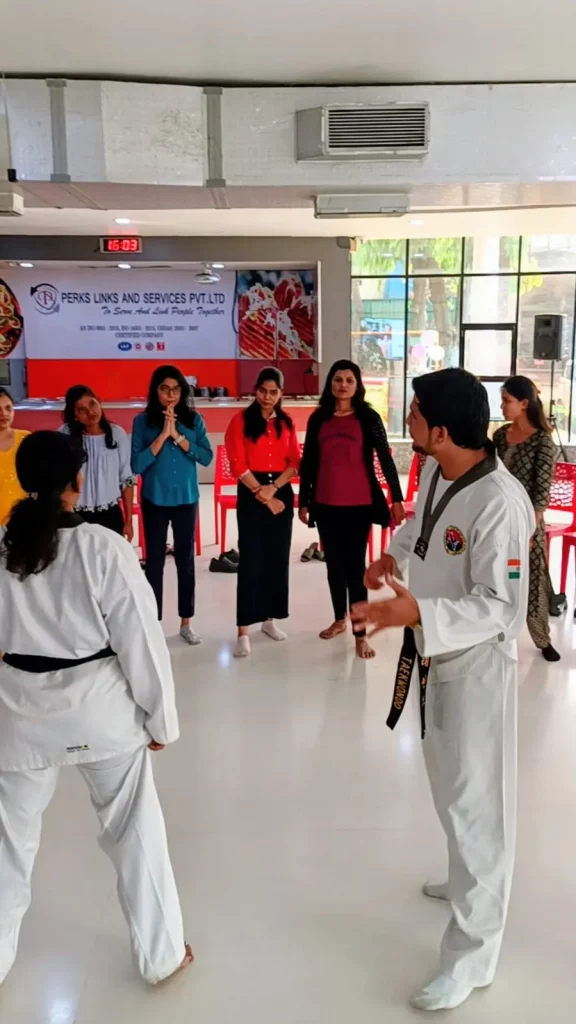
In the current “Commute Era,” where many female employees navigate cabs, metros, and late shifts, safety is paramount. However, traditional workshops often focus too heavily on martial arts theory that takes years to master.
Corporate Swasthya focuses on “The Power Move”—practical, gross-motor skills that can be learned in hours, not years. This isn’t about becoming a black belt; it’s about situational awareness and the confidence to set boundaries.
Women’s self-defense workshops for corporate offices in India must prioritize:
- Situational Awareness: Recognizing threats before they escalate.
- Voice Modulation: Using sound as a weapon to de-escalate or attract attention.
- The “Stun & Run” Principle: Techniques designed to create a 3-second window for escape, rather than engaging in a prolonged fight.
Case Study: Turning a Gift into a Defensive Asset
One of our most impactful interventions involved a large tech firm in Bengaluru. The management had previously gifted 500+ female employees pepper spray canisters. However, a follow-up survey revealed a critical gap: 85% of the women had never tested the spray and were afraid they might hurt themselves if they tried to use it.
We deployed the “Pepper Spray Precision” module to turn these tools into defensive assets.
The “Safety First” Protocol
We moved beyond theory to establish a Standard Operating Procedure (SOP) for non-lethal defense:
- The Wind Factor: We trained employees to check wind direction instantly. Spraying upwind can blow the chemical back into the user’s eyes, incapacitating the victim instead of the aggressor.
- The Safe Zone: According to safety data from manufacturers like SABRE, the optimal deployment range is often between 8 to 12 feet. We marked this distance on the floor to build spatial awareness.
- Spray & Move: We drilled the “Lateral Shift.” After deploying a burst, the user must immediately step sideways. An attacker will instinctively lunge toward where the spray came from; moving laterally keeps the user safe.
The result? Employees transitioned from being “anxious owners” of a dangerous tool to “confident users” of a defensive asset.
Closing the Gap: Strategic Investment Planning for Women
While safety protects the physical self, financial literacy protects the future self. The gender pay gap is a known issue, but the “wealth gap” is often wider. Women generally have longer life expectancies than men, meaning their retirement funds need to last longer. Furthermore, many women take career breaks for caregiving, which impacts compounding interest.
Financial wellness programs for women employees in India need to address these specific milestones. Our sessions move beyond basic savings advice to cover:
- Risk Appetite: Encouraging a shift from traditional, low-yield savings to inflation-beating equity assets.
- The “Longevity Risk”: Planning for a retirement that could last 30+ years.
- Tax Efficiency: structuring salary and investments to maximize take-home wealth.
The Rhythmic Pulse: Why Drum Circles are the Ultimate Ice-Breaker
Corporate hierarchy often creates invisible walls between management and teams. To break these down, we utilize the primal power of rhythm.
Research suggests that group drumming is a powerful tool for stress regulation. A study published in Medical Science Monitor (Bittman et al.) indicated that group drumming can significantly reduce cortisol levels and boost the immune system.
In our “Rhythmic Synergy” sessions, everyone from the intern to the VP is given a djembe. There is no sheet music and no “right” way to play. The goal is synchronization. This shared, non-verbal communication fosters immediate psychological safety and releases dopamine, acting as a massive somatic reset for high-stress teams.
Breaking the Digital Stagnation with Movement Therapy
For the high-octane female executive, stress often manifests physically—tight shoulders, shallow breathing, and fatigue. “The High-Octane Zone” uses Zumba and movement therapy to break this physical stagnation.
Unlike a standard gym session, this is about “zero inhibition.” It is a safe space to move, sweat, and shake off the cortisol accumulation of the fiscal year. The focus is on fun and energy, allowing employees to return to their desks with renewed focus and endorphins.
The Art of Collective Creation: Mandala and Mindfulness
On the opposite end of the energy spectrum is the “Creative Soul” pillar. For teams that require deep focus and calm, we utilize Mandala art.
Engaging in complex, repetitive geometric coloring or drawing acts as “active meditation.” It quiets the “monkey mind” and reduces analysis paralysis. When done collaboratively—with teams working on a giant canvas—it fosters non-verbal bonding and a sense of collective achievement.
Beyond the Chair: Ergonomics for the Female Physiology
Finally, we must address the environment itself. Most office furniture follows a “one-size-fits-all” standard, which often defaults to male anthropometric data. This leaves many women susceptible to musculoskeletal issues.
Research published in the European Spine Journal indicates that women office workers may face nearly double the risk of neck pain compared to their male counterparts. This is often due to desk heights, chair depths, and monitor positions that do not align with female physiology.
Our “Physiology-First” sessions educate employees on:
- The 90-90-90 Rule: Correct alignment of hips, knees, and elbows.
- Monitor Eye-Line: Adjusting screens to prevent “Tech Neck.”
- Micro-Movements: Simple desk stretches to maintain spinal health throughout the day.
The 2026 Mandate
This Women’s Day, the mandate for corporate India is clear. It is time to move past the optics of celebration and invest in the mechanics of empowerment. By adopting the Corporate Swasthya framework, you aren’t just hosting an event; you are building a culture where women feel safe, financially secure, and physically supported.
Ready to deploy these tactical wellness pillars in your office? Contact us to customize your Women’s Day 2026 roadmap.